BLOGGER TEMPLATES - TWITTER BACKGROUNDS �
Showing posts with label botany. Show all posts

Sunday, December 6, 2009

Carnivorous Plants Could Be In Your Backyard


http://craziestgadgets.com/wp-content/uploads/2009/09/life-size-super-mario-plant.jpg
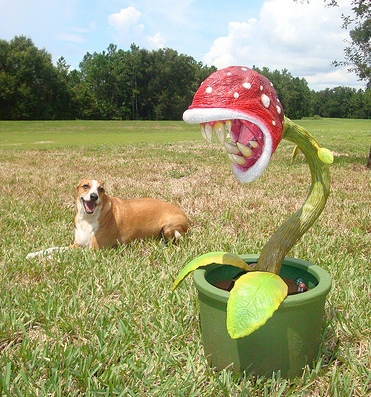

Although man-eating plants have been long debunked, carnivorous plants do exist. The most famous are the venus fly traps, but others include the pitcher plant and bromeliads. These plants eat insects in order to make up for nutrient deficiencies.

We would think that plants either eat insects or not. However, researchers believe this should be a sliding scale of carnivorous-ness. For example, petunias and potatoes have sticky hairs that catch insects, but do not digest them. They suggest that murderous plants are much more common and might digest the breakdown of their victims.

Wiley-Blackwell (2009, December 5). 'Killer petunias' should join the ranks of carnivorous plants, scientists propose. ScienceDaily. Retrieved December 6, 2009, from http://www.sciencedaily.com/releases/2009/12/091204103747.htm

Tuesday, September 8, 2009

From the NO, REALLY Files: "Houseplants Make Air Healthier"

As reported from LiveScience.com:

Houseplants can absorb harmful ground-level ozone and break it down internally. Scientists placed three common houseplants in chambers filled with 10 the normal amount of ozone and timed how long it took for the plants to reduce the ozone to 3% of the initial amount. The plants did so in 50minutes while it took empty chambers 75minutes for the ozone to dissipate.


I in yo office, eetin yo ozone. Nom nom nom.

Ozone high up in the atmosphere forms the ozone layer which prevents us from getting burnt to a crisp from UV-light. Ground-level ozone is harmful and is a component of smog.

Although this is a bigger problem in developing countries because of poor ventilation, offices have copier machines and printers that increase indoor ozone concentrations. In the future, researchers hope to hold more realistic studies by testing how many plants you would need to have a significant reduction and which plants are more efficient at breaking down the ozone.