"Catfish venom glands are found alongside sharp, bony spines on the edges of the dorsal and pectoral fins, and these spines can be locked into place when the catfish is threatened. When a spine jabs a potential predator, the membrane surrounding the venom gland cells is torn, releasing venom into the wound.
Friday, December 11, 2009
"More than 1,000 Catfish species are venomous"
"Catfish venom glands are found alongside sharp, bony spines on the edges of the dorsal and pectoral fins, and these spines can be locked into place when the catfish is threatened. When a spine jabs a potential predator, the membrane surrounding the venom gland cells is torn, releasing venom into the wound.
Posted by Slinxie. at 3:15 PM 0 comments
Labels: fish, marine biology, venomous
Monday, November 16, 2009
Jellyfish Don't Like Japan
Huge swarms of the Nomura jellyfish are threatening the livelihood of Japanese fisherman. These nasty suckers can grow up to 6ft in diameter and weigh up to 450 lbs and look like evil red-orange jello blobs. They easily get snagged in fishing nets and kill the little catch these fisherman are able to bring in.
Posted by Slinxie. at 4:46 PM 0 comments
Labels: global warming, jellyfish, marine biology, oceans pollution
Wednesday, November 11, 2009
Ew, Antarctica is Dirty: Antarctic Lakes Full of Viruses
Alcami and his colleagues analyzed DNA from viruses found in water samples collected fromAntarctica's Lake Limnopolar, a surface lake on Livingston Island. They found nearly 10,000 species, including some small DNA viruses that had never before been identified. In total, the viruses were from 12 different families, some of which may be completely new to science, the researchers suggest. The results reveal this Antarctic lake supports a virus community that's more diverse than most aquatic environments studied in the world so far — a surprising find considering that the polar region is generally thought to have low biological diversity due to the extreme environmental conditions. The scientists speculate the newly discovered viruses may have adapted specifically to thrive in such harsh conditions. The team also found the community of viruses changed dramatically depending on the season. When the lake was ice-covered in the spring, the liquid water under the ice was inhabited by mostly small viruses, but in the summer months when the ice melted, the lake was home to mostly larger viruses. "It looks like a completely different lake in summer," Alcami said. The scientists think the shift might be due to an increase in algae in the summertime, which the larger viruses infect. The researchers hope to figure out whether any of the viruses are unique to Antarctica. If so, that would shed light on whether microbial life evolved independently in Antarctica, which has been isolated for millions of years, or they were introduced there more recently.
Posted by Slinxie. at 12:47 AM 0 comments
Labels: Antarctica, environment, marine biology, virology
Wednesday, October 28, 2009
Using Women's Stockings as Whale Pregnancy Tests
As big as whales are, they are pretty hard to study and keep track of. Most techniques require to kill them in order to examine them. However, scientists think they have developed a way for them to collect biological samples from these animals test to see if they are pregnant or just horny.
Posted by Slinxie. at 12:42 PM 0 comments
Labels: animals, marine biology
Monday, August 10, 2009
RUN! JELLYFISH ARE GOING TO RULE THE WORLD!!!
There are certain things everyone should know about Mother Nature:
1. Some animals are sort of ugly.
2. Animals are trying to kill us.
3. You don't f*ck with Mother Nature. Seriously.
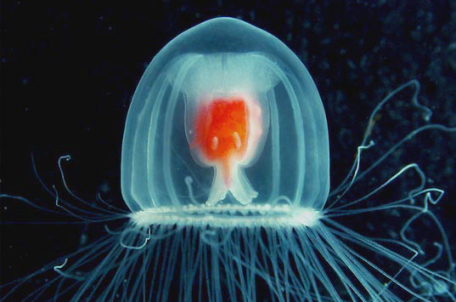
Case in point, Turritopsis nutricula aka the Immortal Jellyfish.
WTF is it? Am I going to run into one? Well, it's a jellyfish. Actually it is a hydrozoan, but it's pretty much a jellyfish. They are normally found in warm tropical waters but is believed to spreading because of ships dumping their water in various ports.
What do they do? They are solitary predators...which is boring. The big deal is that they are theoretically immortal. When they become sexually mature, instead of growing old like the rest of us, they revert back to the polyp stage (in other words, they become babies again). The animals do this via transdifferentiation, which is a fancy way of saying that they can change their cells into a different type of cell. This isn't anything special to certain members of the species either. In laboratory studies, 100% of the jellyfish reverted back to this stage.
What does this mean for me? These animals are only 4-5mm long in diameter meaning you probably won't notice them if they were in front of you. However, you might not have noticed THESE THINGS ARE IMMORTAL. So, it's possible they can continue reproducing but never dying. And possibly combine together in a network to make a big godzilla-jellyfish (Jell-zilla) monster who can kill us all. Although they can't do this NOW, the COULD do it later. Evolution, people. It will kill us all. (Except these jellyfish).
Want to read more on this hiccup in the circle of life??:
Turritopsis nutricula: the world's only 'immortal' creature
Cheating Death: The Immortal Life Cycle of Turritopsis
Posted by Slinxie. at 6:29 PM 0 comments
Labels: animals, biology, marine biology