BLOGGER TEMPLATES - TWITTER BACKGROUNDS �
Showing posts with label animals. Show all posts

Thursday, November 5, 2009

"Male Sabertoothed Cats Were Pussycats Compared to Macho Lions"


We remember sabertoothed tigers as being badass. I mean they had to be, they had awesome fangs and it had a Power Ranger!


As discussed in an earlier post, sexual dimorphism is common in many species. In the case of the prehistoric American lion, males were much bigger than females. However, tigers appeared to be the same size regardless of sex. Since neither cat exists today, how did scientists figure this out?

Fossils. And teeth. Although, you can easily sort fossils into groups based on size you have to consider that the animal grows over time. A bone from a young male could be the same size as an older females. Instead, researchers x-rayed the lower teeth and jaw of American lions and sabertooths. As the cats grow, their hollow teeth become filled with dentin, giving an estimated age.

By plotting tooth cavity diameter and jaw length for both species, it was obvious that the size fell into two groups, regardless of age. There was clear evidence for sexual dimorphism--that the bigger teeth were male and the smaller ones were female. However, the tigers sizes were only based on age--that "males were indistinguishable from their mates."

What does that mean?

Well, there needs to be a evolutionary reason for having bigger males. Bigger males can compete and battle better than smaller ones for resources and females. So if the American lion had big males, then they were more aggressive in competition. Scientists theorized that the lions had 1-2 male-dominated groups of females. The sabertooth tiger, instead shows no real difference in size, suggesting that the males and females existed more equally with no reason for aggression.

Duke University (2009, November 5). Male Sabertoothed Cats Were Pussycats Compared To Macho Lions. ScienceDaily. Retrieved November 5, 2009, from http://www.sciencedaily.com/releases/2009/11/091105121050.htm

Wednesday, October 28, 2009

Using Women's Stockings as Whale Pregnancy Tests


As big as whales are, they are pretty hard to study and keep track of. Most techniques require to kill them in order to examine them. However, scientists think they have developed a way for them to collect biological samples from these animals test to see if they are pregnant or just horny.


Presumably, this would be a relatively simple, cheap and non-invasive way to get more information. To test this method, researchers in Austrailia collected 35 samples from two types of whales. They attached a stocking to a pole and then dangled it over the animals' blowhole when they came up for air. Tada! Whale blow soaked nylons!

Although scientists originally thought whale blow was simply air and water, it actually includes lung mucus. So instead of whales simply blowing air out, they are actually sort of sneezing. Measurable levels of the hormones progesterone and testosterone were also present in the blow, allowing scientists to figure out the sexual health of the animal.

For example, whales that were coming back from tropical waters, where they are thought to breed and bore offspring actually were still hormonally in the breeding period. In the long term sense, scientists hope to discover why certain whales are unable to breed.


Monday, September 21, 2009

Canadian Loch Ness Monster May Exist

The world is full of animals that are undiscovered and/or the subject of myths and folklore. The yeti (not found), Bigfoot (not found), Mothman (not found) and the Loch Ness monster (not found) have been the subject of rumors and blurry photographs. Others like the coelacenth, which everyone thought was extinct til holy crap, they found in off the coast of South Africa in 1938. The question is ultimately, are they real and elusive or are people trippin' off LSD in the woods?

Well, "Cammy" can now be added to maybe-sorta-exists list.
People in Canada have reported to seeing a long, dark monster in Cameron Lake starting in 2004. Fish finder equipment suggested that there is a large thing down there and attempts to send down an underwater camera was lost (eaten?). The search was called off.

The British Columbia Scientific Cryptozoology Club says its most likely an giant eel or sturgeon.


.......Or is it?

(cue X-files music)


Tuesday, September 15, 2009

Snake with Foot Found in China


At the risk of this being photoshopped, I decided to post it for it's wtf-ness rating alone.

From the UK Telegraph:

Dean Qiongxiu, 66, said she discovered the reptile clinging to the wall of her bedroom with its talons in the middle of the night.

"I woke up and heard a strange scratching sound. I turned on the light and saw this monster working its way along the wall using his claw," said Mrs Duan of Suining, southwest China.

Mrs Duan said she was so scared she grabbed a shoe and beat the snake to death before preserving its body in a bottle of alcohol.

The snake – 16 inches long and the thickness of a little finger – is now being studied at the Life Sciences Department at China's West Normal University in Nanchang.

Snake expert Long Shuai said: "It is truly shocking but we won't know the cause until we've conducted an autopsy."

A more common mutation among snakes is the growth of a second head, which occurs in a similar way to the formation of Siamese twins in humans.

Such animals are often caught and preserved as lucky tokens but have very little chance of surviving in the wild anyway, especially as the heads have a tendency to attack each other.


Monday, September 14, 2009

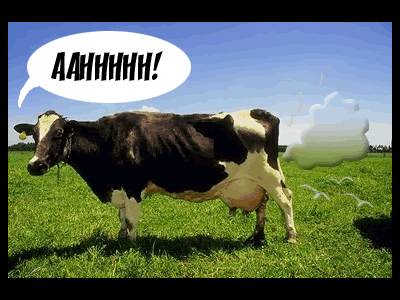
Cows Must Diet to Curb Flatulence


We all have heard about how livestock are one of the worse culprits of global warming. Cows produce up to 250-500 liters of methane a day, which warms the earth 20x faster than carbon dioxide. Also, as one can imagine, there is a lot of energy used in releasing this gas which makes the animals less efficient. The sheer number of livestock in the world plus their extreme gassyness requires some sort of solution before the world is warm and/or stinky from cow farts.


One solution is eat less meat. Yeah right.


Another way is put them on a diet by adding oil or a compoung called tannin to feed which lessens methane formation. "Mootral" is an additive that reduces bacteria essential to methane formation and is being commercially developed.

Although this would help reduce global warming, produce better cows and more profitable farms, there are several obstacles:
  1. The various populations of livestock in the world require different additives based on where they are located and their food source.
  2. Legislation and regulation of feed additives. There are already bans on antibiotic and hormone use in certain countries.
Hopefully some kind of solution will pass to produce a cooler and less stinky world.


Wednesday, September 9, 2009

Hey Boo Boo, Where Is My Pic-a-nic Basket?

Researchers with the South Central Florida Bear Project have been baiting with bears with stale doughnuts and pastries in efforts to attach a GPS collar to them. Every 15minutes, the collar text messages a cell phone letting researchers know where the bear is.


(Note to Self: Avoid solo brownies with whipped cream in the woods of Florida.)


Tracking the animals allows the project to see where the population goes and which habitats are important for conservation. Bears used to wander all over Florida, breeding with different bear populations. Human development has reduced this causing isolated bears who run the risk of inbreeding, lowering their genetic diversity.

When bears are caught, they are tranquilized and measured. They are also scanned for microchips to see if they have already been previously identified by scientists. A fur sample is also taken to see if the animal is related to any others that were caught. If they are old enough, they are fitted with a collar.


Tuesday, September 8, 2009

Forget D.C., Giant Rats Found In Rainforest.

Remember The Princess Bride? Westley and Buttercup had to make their way through the dense forest and encountered these giant M.F-ers?


Well, get ready kids, because this is reality:

Once again, proving if you want some scary sh!t you will go to a rainforest. Scientists found this giant rodent in a remote area of Papua New Guinea. Nose to tail, it is 32.2in and about 3.3lbs. Along with finding a rat "the size of a cat," the researchers from BBC Natural History Unit found about 30 new species including frogs, bats and insects. Although technically the largest rodent in the world is the capybara, which looks like a giant guinea big, I think this one is more traumatizing. Let's hope they can't swim to the mainland.

Monday, August 10, 2009

RUN! JELLYFISH ARE GOING TO RULE THE WORLD!!!

There are certain things everyone should know about Mother Nature:
1. Some animals are sort of ugly.
2. Animals are trying to kill us.
3. You don't f*ck with Mother Nature. Seriously.

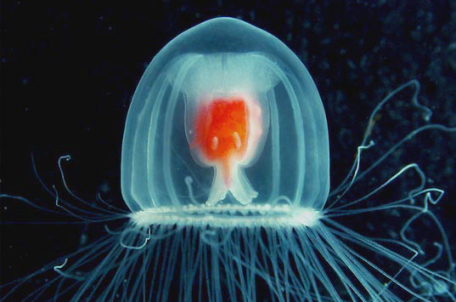
Case in point, Turritopsis nutricula aka the Immortal Jellyfish.


I'm older than Jesus.

WTF is it? Am I going to run into one? Well, it's a jellyfish. Actually it is a hydrozoan, but it's pretty much a jellyfish. They are normally found in warm tropical waters but is believed to spreading because of ships dumping their water in various ports.

What do they do? They are solitary predators...which is boring. The big deal is that they are theoretically immortal. When they become sexually mature, instead of growing old like the rest of us, they revert back to the polyp stage (in other words, they become babies again). The animals do this via transdifferentiation, which is a fancy way of saying that they can change their cells into a different type of cell. This isn't anything special to certain members of the species either. In laboratory studies, 100% of the jellyfish reverted back to this stage.

What does this mean for me? These animals are only 4-5mm long in diameter meaning you probably won't notice them if they were in front of you. However, you might not have noticed THESE THINGS ARE IMMORTAL. So, it's possible they can continue reproducing but never dying. And possibly combine together in a network to make a big godzilla-jellyfish (Jell-zilla) monster who can kill us all. Although they can't do this NOW, the COULD do it later. Evolution, people. It will kill us all. (Except these jellyfish).

Want to read more on this hiccup in the circle of life??:
Turritopsis nutricula: the world's only 'immortal' creature
Cheating Death: The Immortal Life Cycle of Turritopsis


Thursday, August 6, 2009

10 Endangered Species That Are Too Ugly To Live by Atom.com

Taken DIRECTLY from Atom.com:


Scientists love to tell us how we're killing the earth with our indulgences. One day its perfectly fine to hunt spotted owls in old growth forest with a hairspray-fueled flamethrower and the next it's a travesty. I don't get it either.

It's bad enough they're robbing us of our simple pleasures, but they're making hard just to function. If you believe the "facts", you can't even hit the gas on your SUV without 312 of these adorable Pygmy Possums spontaneously croaking.

"Never mind our genocide, you have a mini-mall to get to. We understand."

Even the most jaded among us probably felt a twinge of guilt when you considered how our actions impact that doe-eyed critter. They really are endangered, even more so when you factor in the 7 of them I shook to death for my morning workout. However, for every adorable critter we've pushed to the brink of extinction, we're also doing our part to destroy a bunch of butt-ugly ones too.

The hideous face of genetic diversity

If we all do our part to waste natural resources, the ten horrorshows below will soon be a distant memory. It may seem an impossible dream, but as Lao Tzu once said, "A journey of 1,000 miles starts with a single murder."

1. Hybrid Spider Monkey

Also known as the OMGutaun and Sex Doll Monkey, the hybrid spider monkey lives in small, fragmented populations in Colombia and Venezuela. Humans occasionally hunt them for food, but mostly because that surprised look on their face before they get capped is just priceless.

Mankind has been encroaching on their habitat for years for agricultural purposes. This is unfortunate, but, as any aficionado of Venezuelan blow can tell you, it's totally worth it. The government has attempted to stave this off by sponsoring an anti-drug ad campaign, but so far it has only yielded giggles:


2. California Condor

You've probably heard the old adage "A face only a mother could love". The California condor tests that assertion freshly hatched and then pushes the boundaries further with each day it lives:

If it were aborted, would you know the difference?

People are quick to blame pesticides and loss of habitat for the endangerment of this bird, but it has to have occurred to someone that even their own mothers probably deem them too fugly to live.

This condor is unusual in that it is monogamous and pair-bonds for life. It would be even more interesting if anyone believed that a bird looking like this had any chance in playing the field:


3. Axolotl

This first runner-up in the Endangered Animal Most Resembling My Penis With A Fur Collar competition represents the best reason not to trust Al Gore. He's free to bombard us with as many unfortunate truths about global warming as he likes, but when he doesn't mention punting this creature as an ancillary benefit of it, he's just not being 100% honest.

The axolotl not only has to contend with climate changes vanishing their habitat, but many Mexico City locals collect them for pets. It's a great gift for children to whom you wish to impart "I love you, but not enough to buy you puppy."


4. California Freshwater Shrimp

This creature's rather slight build is probably part of a defense strategy. By remaining largely translucent it will certainly not stand out to predators. It's just a shame that evolution left the visible 20% looking like hunchbacked, scaly turd-casing.

Hiding is also part of its M.O. in terms of habitat choice. It prefers to live in the overhanging vegetation and exposed root structures in riverbeds, much of which is disturbed by local industries (mining, timber harvesting, etc.). The real crime is that these disgusting creatures are more than happy to hide away and industrial greed is now forcing me to look at them. Up yours, mining.

5. Helmeted Hornbill

People always joke that the playpus is an odd assortment of parts, yet it somehow retains a unique charm. This bird looks like someone tried to recreate that magic by cobbling some lung tumors and a massive beak-colored zit together. They failed.

The hornbill's casque is considered very valuable as a source "ivory" for carving tools. Not that cutting off the head isn't its own reward.

6. Aye-Aye

This is an aye-aye after a 3-day weekend filled with ample sleep, gourmet cooking, daily Swedish massages, and hatha yoga sessions. It still has the crazed, harried look of a creature recently dragged behind a truck on a road paved with cactus needles.

The nocturnal lemur is thwarted by both diminishing habitat and the locals' belief that it is an omen of death. This silly superstition is based on nothing more than than the fact that the Aye-Aye is entirely unafraid of humans, the perpetual sneering of its rodent-like teeth, that its long skeletal fingers are designed for harvesting grubs, insects, and souls, that its eyes perpetually burn with flickering hellfire, and that someone in the village dies every time an Aye-Aye crosses their path. Silly backwards primitives!

7. Uakari

The uakari, or Poor Cranial Circulation Monkey, lives in trees in western Brazil and eastern Peru. It is also the winner of the aforementioned Endangered Animal Most Resembling My Penis With A Fur Collar competition, but that really says more about my penis than this similarly unattractive creature. No more topical cream orders from the internet for me!

Their name comes from the indigenous term for "Dutchmen", likely a reference to the sunburned faces of European explorers that uncovered their sunny shores. The Europeans took the joke in stride and playfully got them back by tainting all their gifts to the natives with smallpox.


8. Purple Burrowing Frog

This isn't just a pile of sentient mucus, it's a marketing opportunity:


The south Indian habitat of these burrowing frogs is being encroached upon by the growing needs of the coffee crop. If someone told me I was going to be killing a poor defenseless animal just to enjoy my coffee, I might actually feel a twinge of guilt (though I'd probably mistake it for gas...coffee doesn't sit well with me). But if someone told me it was this monstrosity, I'd probably order a carafe to go. Are you pickin up what I'm sending out, Starbucks?

9. Dugongs

It's hard to imagine how a creature like this could possibly be endangered. You would think that a fat, sedentary dim-witted bottom feeder that would be out-maneuvered by your average slug would would sitting pretty at the top of the food chain, but somehow that hasn't manifested.

The dugong may look like a seal struck with an inflammatory allergic reaction, but it is actually a close cousin of the manatee. Similarly, they suffer issues with destruction of habitat through runoff polution, though the dugong is unique in that it is also prized as a source of meat and oil. They are hunted by placing a large net twenty feet in front of them, which will ensnare them upon reaching it 3 days later.

10. Snake Skin Hunter Slug

Slugs aren't generally known for their rakish good looks, so to stand out as repulsive by their standard is really noteworthy. This slug not only emulates the color of vomit, it goes the extra mile to copycat its texture as well.

Not a lot is known about this creature. This is partly due to them being so scarce, partly because no biologist wants to pull the short straw and spend their day studying a yellow turd.

Special thanks to Scientific American and the Endangered Ugly Blog.